FREE SHIPPING ON ORDERS OVER €100*FREE SHIPPING ON ORDERS OVER €100*




Candle Makers Guide: how to make a candle worth 30€

How to make a candle worth 30€ and how to explain its value.
A customer sees a €3.90 candle on a mass-produced shelf and then sees your handmade candle for €30.
The question is obvious: why such a big difference?
The answer isn’t simply “because it’s handmade.” That alone isn’t enough. The real answer lies in the recipe, the safety, the testing, the ingredients, the consistency, and the way the product burns from the first use to the last.
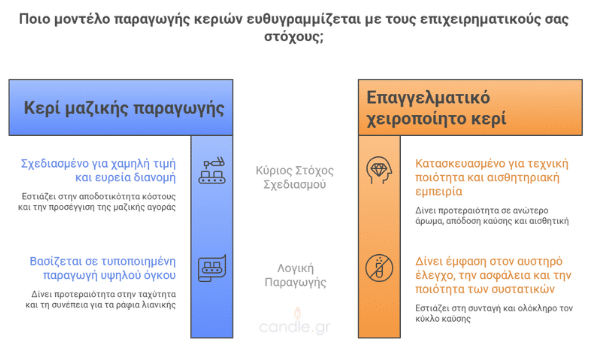
A mass-produced candle and a small-batch professional candle do not necessarily follow the same logic.
One is often designed for a low price, wide distribution, and mass production. The other must win people over with technical quality, aesthetics, aroma, burn, and the overall experience.
If you’re a candle maker, a candle artisan, or a small business, this article is your checklist. It’s not about making excuses. It’s about knowing what you’re selling, why you’re selling it at that price, and how to explain it clearly.
In this article
1. The base candle: not all candles are the same
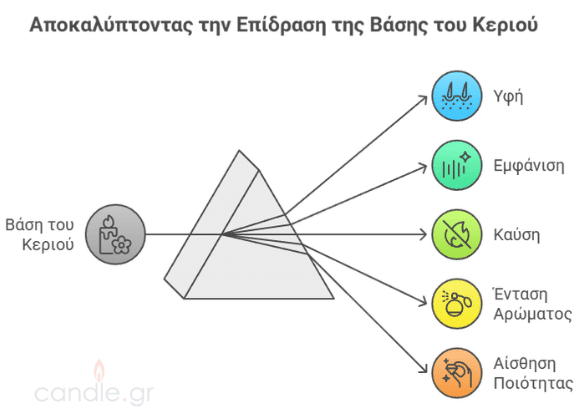
Η base of a candle is not just “candle”. It is the body of the product. On it depend the texture, appearance, burn, intensity of aroma and sense of quality.
An soy wax, an olive wax, beeswax or a beeswax candle Blends don’t all behave the same way. Some waxes produce a creamier surface, others offer better heat resistance, others have a different “hot throw,” and still others provide a more natural scent profile. There’s no one “right” choice for everyone. However, there is a right choice for the product you want to create.
The Candle Maker who wants to stand professionally must know why he chose his base. Not because “everyone uses it”, but because it fits the container, the perfume, the wick, the audience and the price of the product.
What you should be able to answer:
- Why do you use this wax?
- How does it burn compared to the scent you’ve chosen?
- How does it behave in this particular container?
- Is it consistent across your batches?
- Does it align with your brand’s positioning?
A premium product starts from a selected base. Not from random wax that just melts and goes into a glass.
2. The fragrance: the heart of the product
The perfume for candle is often the reason why the customer buys. It is also one of the main reasons that a handmade candle can vary significantly in cost and
quality. It is not enough to have a A fragrance that smells good in the bottle. That’s just the beginning.
The real test is what it does inside the wax.
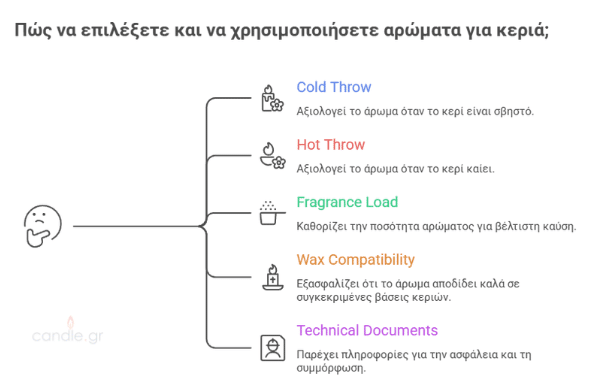
A candle maker should consider the following:
- Cold throw: how the candle smells when it’s unlit.
- Hot throw: how the scent is released when the candle is burning.
- Fragrance load: the amount of fragrance that works properly without interfering with the
combustion. - Compatibility with the wax: Not all fragrances perform the same way on every base.
- Technical documents: IFRA, SDS and other information where appropriate.
The IFRA Standards function as international risk management system for the safe use of fragrance ingredients and may set limits, restrictions or bans on specific materials where there is a safety concern. This does not mean that Candle Maker should scare the customer with technical terms. It means that he should know what he is using.
A professional candle is not based on “I put on a little fragrance and it smells good”. It is based on selection, testing and repetition.
3. The wick: the small component that destroys or lifts the wax
The wick for wax is only small in the eye. In practice, it is the combustion mechanism. The right one The wick depends on the diameter of the container, the type of wax, the scent, the fragrance load, the color, and the overall composition.
The same wick may work perfectly in one candle and poorly in another. The wrong wick can cause tunneling, a weak melt pool, an excessive flame, increased temperature in the container, or more soot. This doesn’t necessarily mean the product is “bad.” It means that It is not set correctly for this particular recipe.
A €30 candle must have gone through wick sizing. Ο Candle maker must have tried different wicks, taken notes and know why they ended up with that particular one.
4. The burn test: this is where the value is built
Η combustion test is the point where you can tell if you’re making a product or just an object. A candle is not only evaluated when it comes out of the mould beautifully or when it smells strongly on the first day. It is evaluated when it lights up. And light up again. And continue to burn properly after many hours.
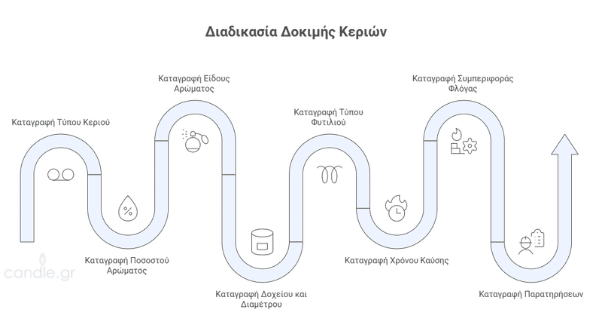
In the combustion test, you check:
- if a proper melt pool is formed
- if the candle burns evenly
- if the flame remains steady
- if the container reaches an excessively high temperature
- if the scent remains pleasant and balanced
- if there is a lot of wax left on the sides
- whether the product functions properly until the end
Candle.gr already has guides that emphasize the importance of notes in tests, such as candle type, wick, container diameter, scent, and quantity, as well as tips for proper burning. In addition, measuring burn time by weighing the candle and conducting controlled burn tests is a useful tool for candle makers to determine the lifespan of their products.
This is where much of the value lies. The customer isn’t just paying for the wax and the scent. They’re paying for the failed test runs they never saw. The wick replacements. The rejected jars. The notes, the corrections, the batches that never made it to market because they weren’t good enough. This isn’t an exaggeration. It’s a production responsibility.
5. The container and the presentation
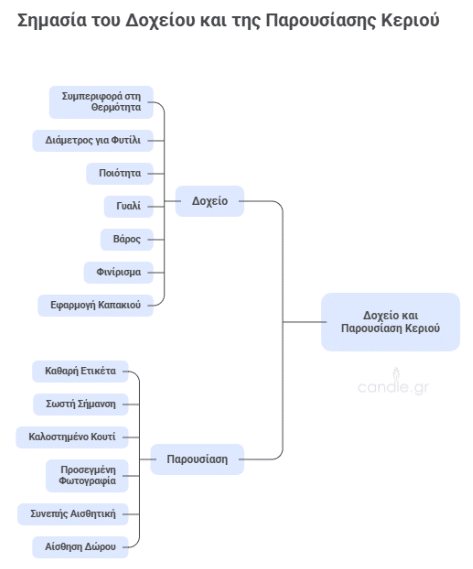
The container is not just decoration. It affects safety, combustion, the feeling of quality and the final experience. A good A candle container must have appropriate heat resistance, the correct diameter for the wick you’re using, and a quality that justifies the product’s price.
The glass, the weight, the finish, and the way the lid fits—if there is one—create the first impression even before the candle is lit.
Next up is the presentation:
- plain label
- proper signage
- well-made box
- a well-composed photograph
- consistent aesthetic
- the feeling of receiving a gift, without going overboard
Not every candle needs to look like a magazine editorial. But it does need to show that someone thought of it. If you’re asking for a premium price, the presentation needs to support the message. Not give it away.
6. Compliance and safety
Compliance is not the most “attractive” part of candle making. But it is one of the most serious. When using fragrances and putting a product on the market, you need to considerlabeling requirements and technical documents that come with your materials.
The The CLP Regulation covers the classification, labelling and packaging of substances and mixtures in the EU so that the risks of chemicals are clearly communicated before they are placed on the market. Η ECHA (European Chemicals Agency) says that labels may include items such as a warning word, pictograms, hazard statements and precautionary statements, depending on the classification of the product.
For the Candle Maker, this essentially means:
- Keep the SDS and IFRA documents for your fragrances
- Check whether a CLP label is required for your formulation
- Don’t blindly copy other people’s tags
- Keep batch records
- used a set recipe
- Consult a specialist when in doubt
This is not legal advice. It’s professional hygiene. A candle worth €30 should show that there is responsibility behind it, not just a good smell.
7. The history of the Candle Maker
History helps. People want to know who makes the product, why they make it, what inspires them and what makes them tick separate. But history alone cannot uphold that honor.
The fact that something is “handmade” isn’t enough to justify a high price. Something handmade can still be shoddy. Value comes when the story is grounded in quality, craftsmanship, and consistency.
If you say, “I make candles with love,” that’s lovely. But if you say, “I test each scent with a different wick, keep notes on how they burn, and choose the wax that best suits that particular blend,” then the customer hears something more compelling.
8. How to explain the price to your customer
When someone compares the price of a handmade candle to a cheaper mass-produced candle, don’t get defensive. Don’t underestimate the other product. Don’t start apologizing. Explain the category difference. You can use phrases such as:
- “The price is not just the material. It’s about testing, safety and stability.”
- “Each fragrance is tested individually with the right wick, because not all fragrances burn the same way.”
- “I’m not just selling a candle. I’m selling an experience that burns just right until the very end.”
- “A good candle shouldn’t just smell nice on the first day. It should burn properly every time.”
- “The product involves costs for materials, testing, packaging, time, and reproducibility. That’s what you’re paying for.”
- “We don’t just compare prices. We compare production processes, material selection, and the final result.”
A calm demeanor sells better than a defensive one. When you understand your own worth, the customer is more likely to understand it, too.
9. Checklist: when a candle can be worth 30€
A handmade candle can stand in premium price when it has specific items behind it. If many of these are missing, the price becomes a wish. If there are, the price becomes a reasonable result.
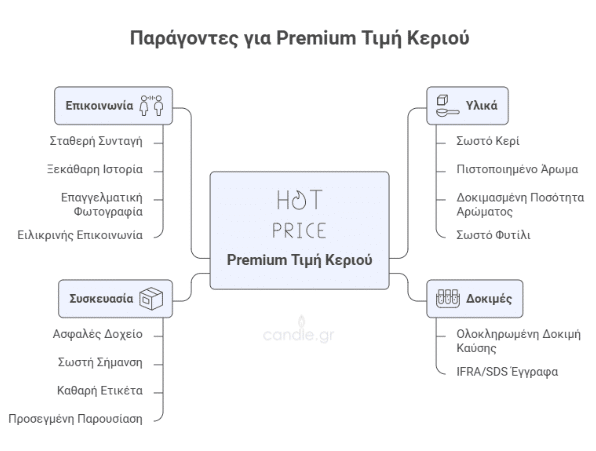
If you make candles, this is your checklist. If you buy candles, now you know what to look for.
A candle worth €30 isn’t just the result of a nice idea. It’s created using the right materials, a technical process, testing, consistency, and clear communication.
At Candle.gr, you’ll find the materials and tools you need to create this level: waxes, certified fragrances, wicks, containers, and technical guides for makers who want to work more professionally—not just create more beautiful products.
Frequently Asked Questions:
Is it enough to be handmade to be good?
No. Handmade is a way of production, not a proof of quality. A good handmade candle must have the right recipe, the right wax, a tested scent, the right wick, a safe container and a stable burn.
Why does a handmade candle cost more?
Because the price does not only include the candle and the perfume. It includes testing, production time, proper wick, container selection, labeling, packaging, failed samples, photography and smaller scale production. A professional small production wax has a different cost rationale than a mass produced product
How important is the wick?
Very important. The wick affects the flame, melt pool, combustion, pot temperature and overall performance of the fragrance. Even a great candle or perfume can fail if the wick does not fit the composition.
What is the burn test?
A burn test is the process of testing a candle when it burns. The Candle Maker observes the flame, the melt pool, the temperature of the container, the intensity of the aroma and the behavior of the candle in multiple uses. It is an essential step before a candle goes on the market.
How do I explain my price to a customer who compares it to supermarket wax?
Don’t answer defensively. Explain that this is a different product category. You can say: “The price is not just the material. It’s the testing, safety, the right wick, the choice of fragrance, and consistency in burning.” This moves the conversation from “why is it so expensive?” to “what exactly am I paying for?”